pattern works
AI agents you can follow. Outputs you can review.
We build n8n agents with reusable skills, accessible knowledge and connected tools. Visual execution records and Airtable review interfaces help you follow the work, question an output and improve what happens next.


Airtable review interfaces

Rules, knowledge and skills

A shared GitHub skill library

Testing real work together

Support as your work changes
See how we
build AI
systems.
We combine n8n agents, shared guidance and human review. Explore the decisions, tools and evidence behind our work.
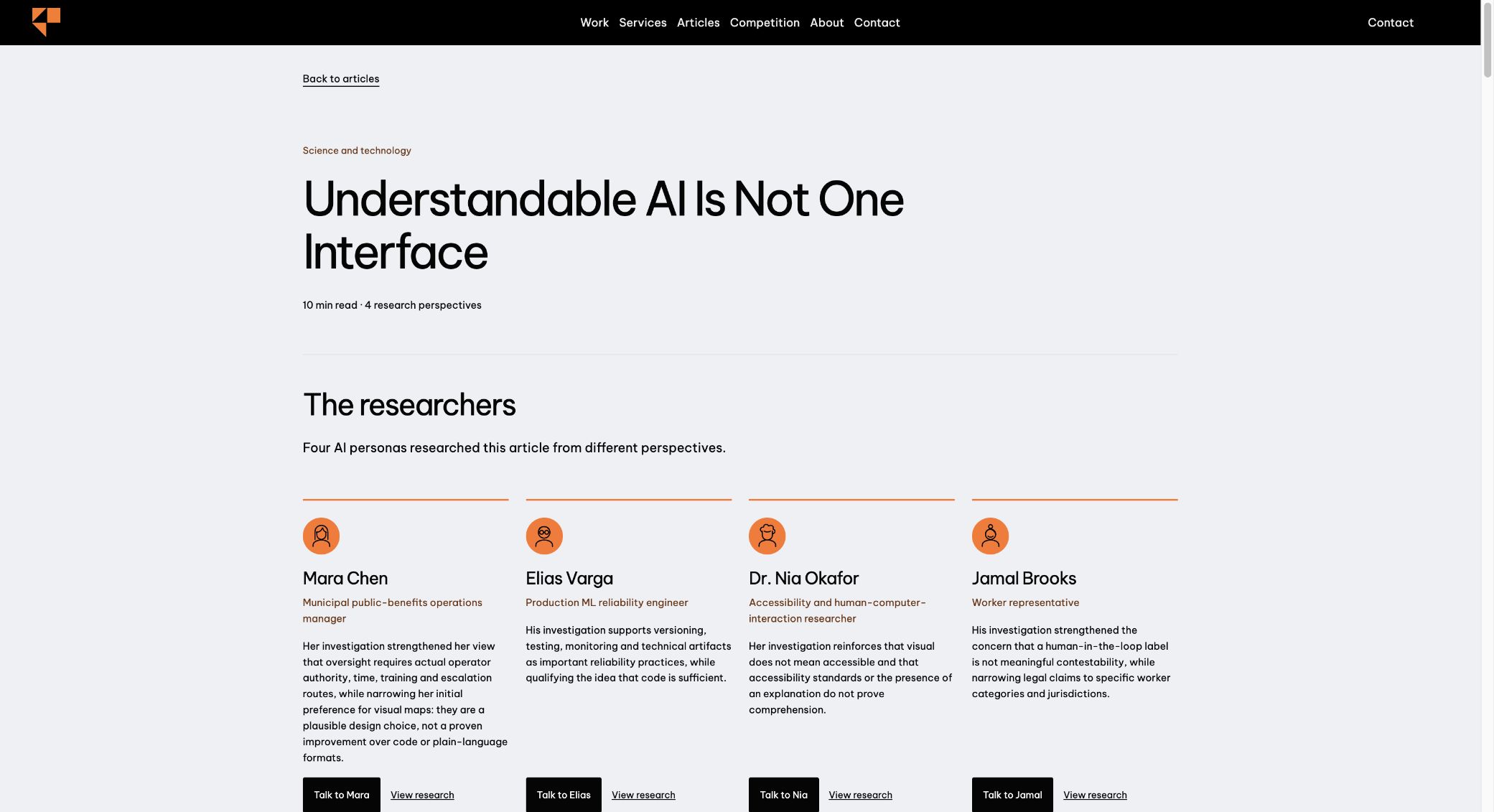
Living Articles is our research and publishing demonstration. Its agents, saved work and review process make the approach concrete.
Read the saved articleMapping your process
We always err
on the side
of simplicity.
Mapping the process is the most important part of the work, and the part that requires the most judgement.
We decide what should become an agent, what should become a semi-deterministic workflow and what should become a deterministic workflow.
A process will often involve all three. We lean on agents where possible, integrating workflows where efficiency, cost and the task make them worthwhile.
How we map your processAgent
Does work itself.
Executes the workflows it needs.
Deterministic
workflow
Semi-deterministic
workflow
Give the agent
what it needs.
Rules set the boundaries. Skills guide the task. Documents and retrieved knowledge give the agent context.
An n8n agent can use a tool directly or call a workflow. We make those choices around the job and the records your team needs to inspect.
Why a shared skill library?
GitHub keeps skills and guidance in a versioned library. We agree how approved versions reach people and agents. Rules and reference material can stay in accessible tools such as Airtable.
How we equip an agent / illustrated structure
Rules
Boundaries
and checks
Skills
Task guidance
and tools
Knowledge
Documents and
retrieved sources
n8n Agent
Article Writer
Works from its guidance.
Chooses the tools the task needs.
Use a tool directly
Read, retrieve or take
a bounded action.
Call a workflow
Coordinate steps with
an execution to inspect.
An explanation.
And the records
to check it.
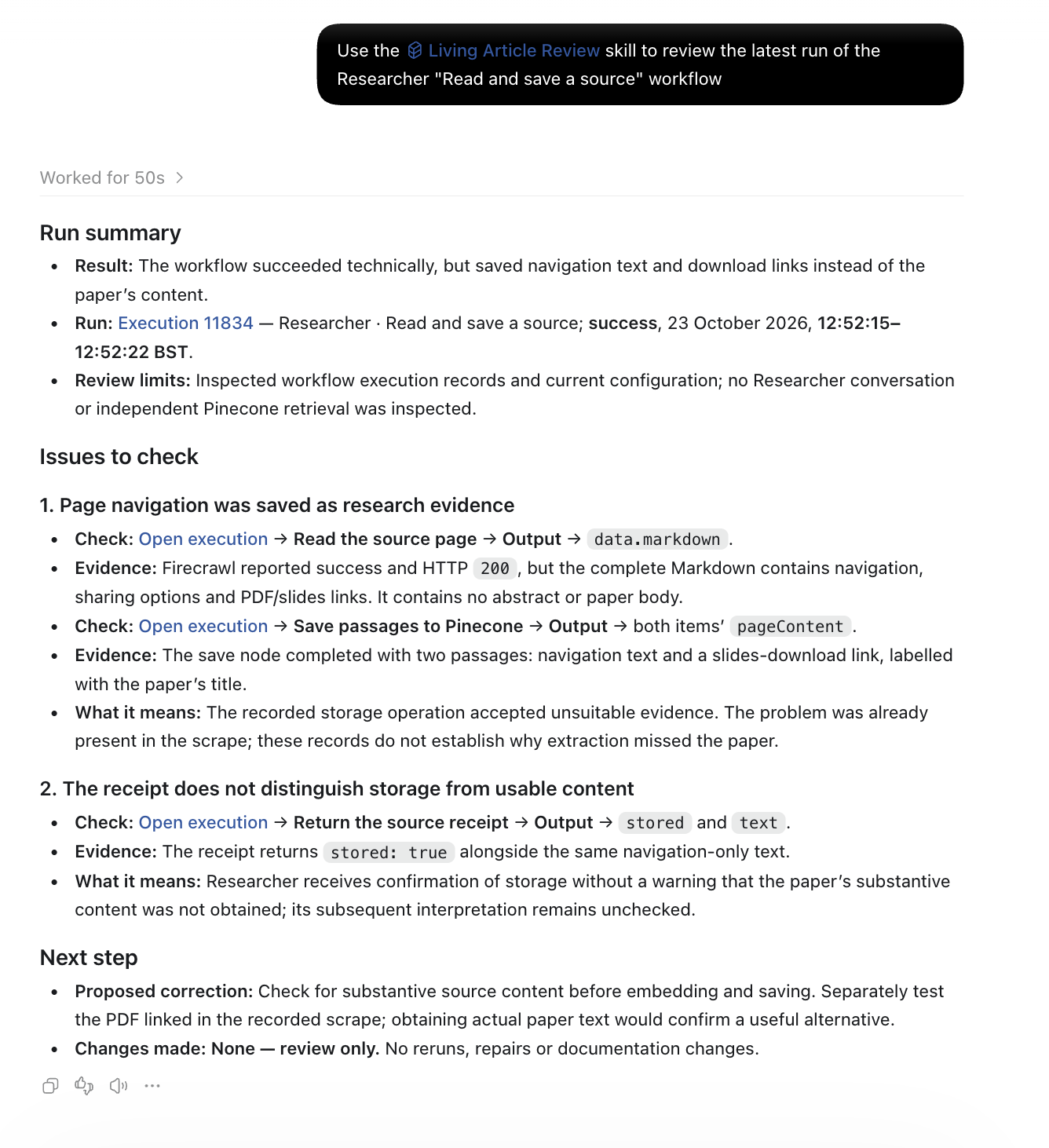
Watch a Codex skill use n8n MCP to review a run, then follow its links to the recorded node output.
Check the
explanation yourself.
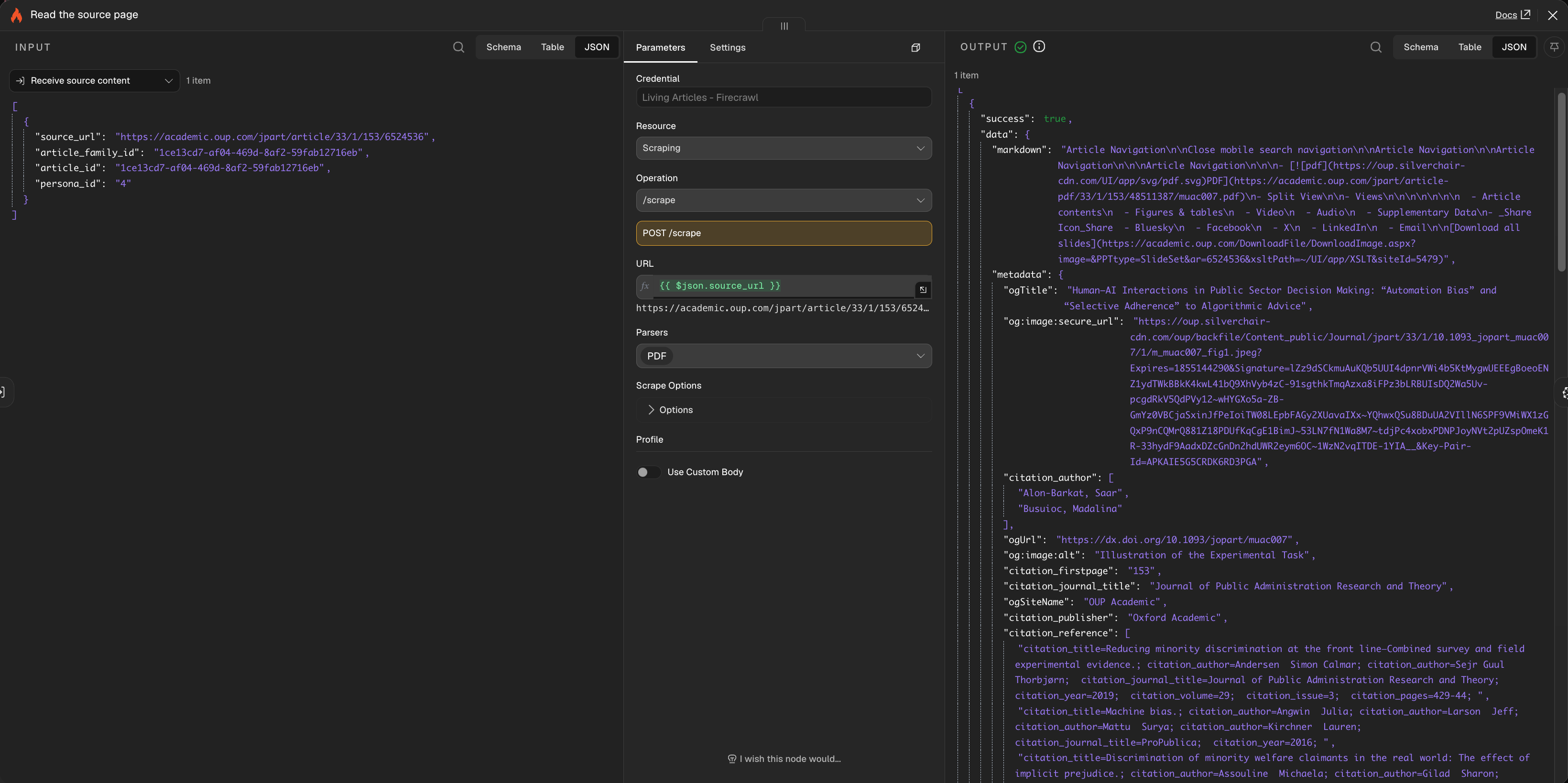
Open the named node and inspect what it actually returned. In this run, the scrape captured navigation and download links instead of the paper’s content.
An explanation.
And the records
to check it.
A skill-guided agent can use n8n MCP to locate a run and point to the relevant steps. You can open the execution, inspect its inputs and outputs, and check the explanation.
One Living Article run finished successfully but produced a very short article. Its saved outline and section plan showed why.
Why visual execution records?
The record shows what ran. Your expertise is still needed to judge whether the result is right.
Recorded investigation / 16–17 October 2026
The run finished.
The article was too short.
01
Start with the output
493 words. One body section.
02
Follow the saved outline
The planned material sat beneath one shared parent heading.
03
Inspect the section plan
The writer was scheduled to produce one section.
Corrected outline test: 8 writing tasks.
Later article: 8 body sections.
Evaluate the
whole output.
We develop a metric with you and your domain expert, then use an LLM judge to mark the whole output and recommend improvements.
Deterministic checks look for problems along the way, including missing context, broken routing and the wrong output version.
Start with a set you can review. Refine the metric together, test changes and scale up when the work calls for it.
How we run evalsInputs
A manageable set
Run the
workflow
Save the
outputs
Deterministic
checks
Did the right context arrive?
Did the required steps run?
Whole output
+ your metric and judging instructions
+ your metric and judging instructions
LLM judge
Assess the whole output.
Mark + recommendationsHuman review
Review the checks, marks and recommendations.
Refine the metric or workflow.
Run the cases again.
Pattern Works, in practice
Living Articles.
Our approach,
in action.
A research and publishing project built with AI agents. See how we equip those agents, connect their tools and make their work available for people to inspect.
Explore the project and the thinking behind it.
Read a saved article01 / Meet the project
A result you can read.
A system you can explore.
Agents investigate different perspectives, develop an article and let readers question the ideas behind it. Living Articles gives us a real project through which to explain how we build.
The interesting part is how those agents are equipped: their responsibilities, guidance, knowledge and tools, and the records that help us examine their work.
Why Supabase?
Explore the saved article It stores the research, articles and personas behind the website. Serverless functions connect the interface to that saved data and the agents, giving the project a shared database and backend.
02 / Equip the agent
Give the agent
what it needs.
The agent has a job to do. Rules set its boundaries. Skills guide particular tasks. Documents and retrieved knowledge supply context. Tools let it act.
In n8n, an agent can use a tool directly or call a workflow when an operation needs coordinated steps. We design those choices around the work and the evidence people need to inspect.
Why a shared skill library?
GitHub gives guidance a shared source and version history. We agree how approved skills reach each person and agent. Rules and reference material can live in accessible tools such as Airtable or a document library.
How we equip an agent / illustrated structure
Rules
Boundaries
and checks
Skills
Task guidance
and tools
Knowledge
Documents and
retrieved sources
n8n Agent
Article Writer
Works from its guidance.
Chooses the tools the task needs.
Use a tool directly
Read, retrieve or take
a bounded action.
Call a workflow
Coordinate steps with
an execution to inspect.
03 / Investigate a result
An explanation.
And the records
to check it.
A skill-guided agent can use n8n MCP to help find the relevant run, identify steps to inspect and point us towards their inputs and outputs. We can then open the execution and check the explanation against what ran.
In one earlier Living Article investigation, a successful run produced a very short article. Following its saved outline and section plan revealed why.
Why visual execution records?
See the investigation in context They give people a route from a questionable result to the work behind it. Seeing what ran helps an investigation; judging whether the output is good still needs human expertise.
Recorded investigation / 16–17 October 2026
The run finished.
The article was too short.
01
Start with the output
493 words. One body section.
02
Follow the saved outline
The planned material sat beneath one shared parent heading.
03
Inspect the section plan
The writer was scheduled to produce one section.
Corrected outline test: 8 writing tasks.
Later article: 8 body sections.
04 / Keep people involved
Your judgement
has somewhere to go.
Living Article’s feedback reviewer uses Jev to assess concerns from reader conversations and prepare useful suggestions. Recorded tests show proposals being grouped and saved.
For client work, we can bring outputs, supporting evidence and suggested changes into an Airtable interface. People can review, correct and decide what should proceed, then help improve the guidance behind the agent.
Why Airtable?
It combines accessible data with interfaces that colleagues can use for QA and review. Your team can work with the records and build on that view as its needs change.
Demonstrated here: feedback assessment and saved proposals. The Airtable review interface is an illustrated delivery option.
Illustrative review item
Add a worked
example.
The concern
The explanation needs a concrete example that a reader can apply.
The evidence
Relevant reader comments and the passage they refer to, available together for review.
The proposed change
Prepare an example for the editor to assess.
Your decision
Bring this way of working
into your business.
Start with a job you know well. We’ll work with you on the agent, its guidance, connected tools and how you review the results.
Our own development project
See the work.
Question the result.
Living Article brings research, writing, sources and discussion into one system. Explore a saved article, then see how we investigate the work behind it.
See how we work ↗Start with the work you want to improve.
Work out where AI can help, build an n8n agent around a recurring task, or improve a system you already use.
Explore our services ↗