Skip to the main content

AI agents and visual workflows.
Built and improved with you.

AI agents, visual n8n workflows and Airtable review interfaces. Built with your knowledge, reusable guidance and skills, so you can understand the work and have a hand in improving it.

Ways to work
together.

Consultancy, a scoped project or ongoing collaboration. We agree what’s included, your involvement and the fee before paid work starts.

Consultancy &
investigation

Work out where AI could help, or investigate a workflow that needs attention.

  • Review your process, tools and real examples.
  • Identify useful changes, constraints and what to test.
  • Written findings and recommended next steps.

Scoped consultancy. Agree the questions, outputs and time. The findings can stand on their own.
Build &
repair

An agent and visual workflows for a defined task, or changes to an existing system.

  • n8n workflows, skills and app connections.
  • Review interfaces and evaluation checks developed with you.
  • Testing, documentation and a walkthrough.

A scoped project. Agree the deliverables, checks and project quote before the build.

Ongoing
improvement

Keep improving the system as you use it and your work changes.

  • Review outputs and investigate problems.
  • Refine guidance, metrics and workflows.
  • Test changes and review them together.

Sessions or a block of time. Agree the systems, work and time covered.

Bring a task, a brief or a workflow that needs attention. We’ll discuss a suitable starting point and explain any tool or usage costs separately.

Book a discovery call

You don’t have to figure it all out alone

You know the work.
We help build the system.

For founders, small teams and people improving a process inside a larger business. Here is the work we can help take off your plate.

With Pattern WorksDoing it yourself
Hands-on help with n8n, Airtable and AI
Learning and connecting the tools yourself
Rules, knowledge and skills organised with you
Working out what to tell the agent
Outputs you can check, correct and approve
Building your own review process
Real examples, testing and troubleshooting
Finding time to test and debug
Shared skills with a clear version history
Keeping copies and updates in step
Help improving the system as you use it
Maintenance on top of your other work

You stay involved in the decisions that matter. We bring the tools and implementation, and work with you on the knowledge behind the task.

Book a 30-minute discovery call ↗

Consultancy & investigation

Understand the work.
Shape the guidance.

We work through your process, tools and examples to identify what could help, what needs investigating and what should stay with a person.

Start with a job you already do: handling enquiries, preparing reports or checking documents. We work through real examples with you, draw out the decisions behind them and organise the guidance an agent needs.

Rules, knowledge or skills?

Rules set the boundaries the agent must follow. Reference material holds the information it needs to find. Skills explain how to carry out a task, with the right tools and checks. We work out what belongs where, who maintains it and which decisions stay with you.

Rules

What must always happen.

Knowledge

Sources the agent can find when it needs them.

Skills

How to do the task, which tools to use and what to check.

We develop the guidance with you. Your experience and judgement shape what the agent should do.

Mapping your process.

The most
important part
of the work.

Mapping the process is the most important part of the work, and the part that requires the most judgement.

Left to its own devices, AI will typically create something madly complex. Deciding what should become an agent, a semi-deterministic workflow or a deterministic workflow needs deliberate judgement. We always err on the side of simplicity.

When an n8n system starts to look like spaghetti, that is a warning sign. We want a clean, organised system that you can follow.

There are three buckets. All differ considerably, and all need to be selected very appropriately.

Deterministic
workflow

Typically pure code or inbuilt n8n native nodes, with no LLMs or LLM agents involved.

There is nuance here: a Jev-type or classification model could handle a prescribed decision within that workflow.

For example

Take a completed form, create a record and assign it using rules you have already defined.

Semi-deterministic
workflow

Uses AI within a predetermined workflow, which can include chained AI calls.

Appropriate when costs matter and you want the process to be the same every time.

For example

Read an enquiry, extract what is needed, draft a response and check it through a predetermined sequence of AI calls.

Agent

An agent is a lot more flexible and a lot more autonomous. It can do things much more flexibly, which is absolutely necessary for a whole range of different tasks.

It is a lot easier to maintain: you don’t need to keep creating new workflows for every variation.

For example

Investigate an enquiry, ask follow-up questions, find the information needed and choose the appropriate tools as the task develops.

A process will often
involve all three.

The agent typically does work itself and executes deterministic and semi-deterministic workflows.

Our biggest priority is keeping things simple. We lean on agents where possible, integrating deterministic and semi-deterministic workflows where efficiency, cost and the requirements of the task are particularly important.

Build & repair

An example of how the parts connect

n8n

An agent uses skills and calls visual workflows.

Airtable

Outputs and their status appear in a review interface.

You

Check. Correct. Approve.

Illustrative setup. The workflow, review steps and permissions are designed around the work you need to do.

Build the system.
Make the results reviewable.

We build agents in n8n, equip them with skills and connect the workflows and apps they need. We can store outputs in Airtable and build interfaces where you review, correct and approve them before the next step.

You can follow the process, inspect a result and help improve the system without having to read all the code.

What do we build together?

The agent, reusable skills, visual n8n workflows, app connections and review interface needed for the task. We agree the boundaries, test representative cases with you and provide the documentation and walkthrough you need to use it. We can also repair or extend a system you already have.

Ongoing improvement

Keep the knowledge.
Keep improving it.

We can organise your guidance and skills in a shared GitHub library, with a record of what changed. We help connect the right versions to your agents and agree how you and your colleagues install updates.

As you use the system, we work through results with you, refine the guidance and test changes against real examples.

How does this work across a team?

We agree who owns each skill, who can change it and how a reviewed version reaches each person or agent. GitHub provides the shared source and version history; installation and rollout depend on the agent environment. Where practical, reusable guidance stays separate from provider-specific connections, so a change of provider does not mean starting the library again.

GitHub skill library

One shared source.
A history of changes.

Review a changeTest itRoll it out
An agreed update process keeps the shared library and the versions people actually use in step.

How we check the work

Start with a set
you can review.

These checks help us assess a new build and test improvements to an existing system.

A manageable starting point might be 1–20 inputs. Retrieve them, run the workflow, save the outputs and evaluate them, with deterministic checks along the way.

We work with you and your domain expert to develop the metric. An LLM judge uses it to mark complete outputs and recommend improvements. Where useful, agreed examples show what a good result looks like.

Review the findings together. Tinker with the metric as you find nuances you hadn’t factored in, then test the changes.

Collect inputsRun the workflowSave outputsEvaluateReview and adjust
What do deterministic checks tell us?

They test explicit rules without asking a model to interpret quality. For an article workflow, we might check:

  • Did the required research return a result?
  • Did the brief and required sources reach the writer?
  • Does each citation ID map to a saved source?
  • Did the judge receive the correct article version and metric?

A check can show that a citation exists. Assessing whether the source supports the argument takes further judgement.

Do we always need an LLM judge?

No. Some outputs can be checked against an exact expected answer using rules. Others need human review, an LLM judge or a combination. Reference examples can help express the standard, but a good article doesn’t have to copy one gold-standard answer.

How much
do we automate?

Our recommendation is to tinker with the metric slowly and keep the evals manageable for a human to review. Sometimes deadlines push for a more automated approach, and that is fine.

Choosing the amount of automation based on the metric and the turnaround needed
Where we are with the metricSlower, more deliberateShort turnaround — need something quick
Still finding nuances we didn’t factor into the metric

Tinker with the metric slowly and iterate on it until we’re happy with it.

Deadlines can push us towards a more automated approach, and that’s fine. But we still need a carefully thought-through metric and checking process.

Happy with the metric and checking process

Run a controlled set of evals that are manageable for a human to review alongside the recommendations.

Scale up the operations, go in bulk and automate those processes. The automated process will only ever be as good as the model and metric combination.

You can’t shortcut the metric
and checking process.

It needs to be done effectively, with the domain expert and the business.

Taste isn’t something you can just generate automatically without a relationship. You have to spend time encoding your taste into the metric.

Scale up
the operations.

The same evaluation loop can run across a larger dataset, with more cases running at once. Classification models can help sort recurring issues or route cases for review.

We choose the nodes and storage around the job. That might mean n8n’s built-in evaluations, or a different setup using Airtable, Supabase and other tools.

You still need a manageable way to review the findings and recommendations. A proposed improvement also needs checking for unnecessary complexity.

A larger set of inputs
Run + evaluateRun + evaluateRun + evaluate
Results, checks + recommendations
A manageable set for human review
Illustrative parallel runs. Actual capacity depends on the setup and provider limits.

The tools we know and use

The tools behind
the work.

We favour tools that make the work visible and give you something you can build on. We also adapt the approach to the tools you already use.

n8n

Agents and visual workflows that connect your apps and make the steps available to inspect.

Airtable

Data and review interfaces for non-technical people. Check outputs, record decisions and build on the information.

GitHub

A shared home for guidance, skills and scripts, with version history and a clear way to review changes.

Supabase

A database and backend when the work calls for SQL, APIs or a custom application.

For work that people need to review regularly, Airtable is often our preferred interface. Supabase is another option when a database and a custom interface better fit the job. We agree the tools, access and running costs with you.

Consultancy & preparation

Find a useful
starting point.

Your team knows the work. We help identify where AI could make a useful difference and what needs to be in place first. That might be clearer guidance, better access to information or one small task worth testing.

What could we work on?

An investigation, findings and options, a process map, organised source material, reusable guidance or a test plan. We agree the output and the expert time needed. The findings can stand on their own.

Make the knowledge usable

Real examples
Your team’s judgement
Guidance you
can test.
Illustration: working through examples can reveal the guidance an agent needs, and the decisions a person should keep.
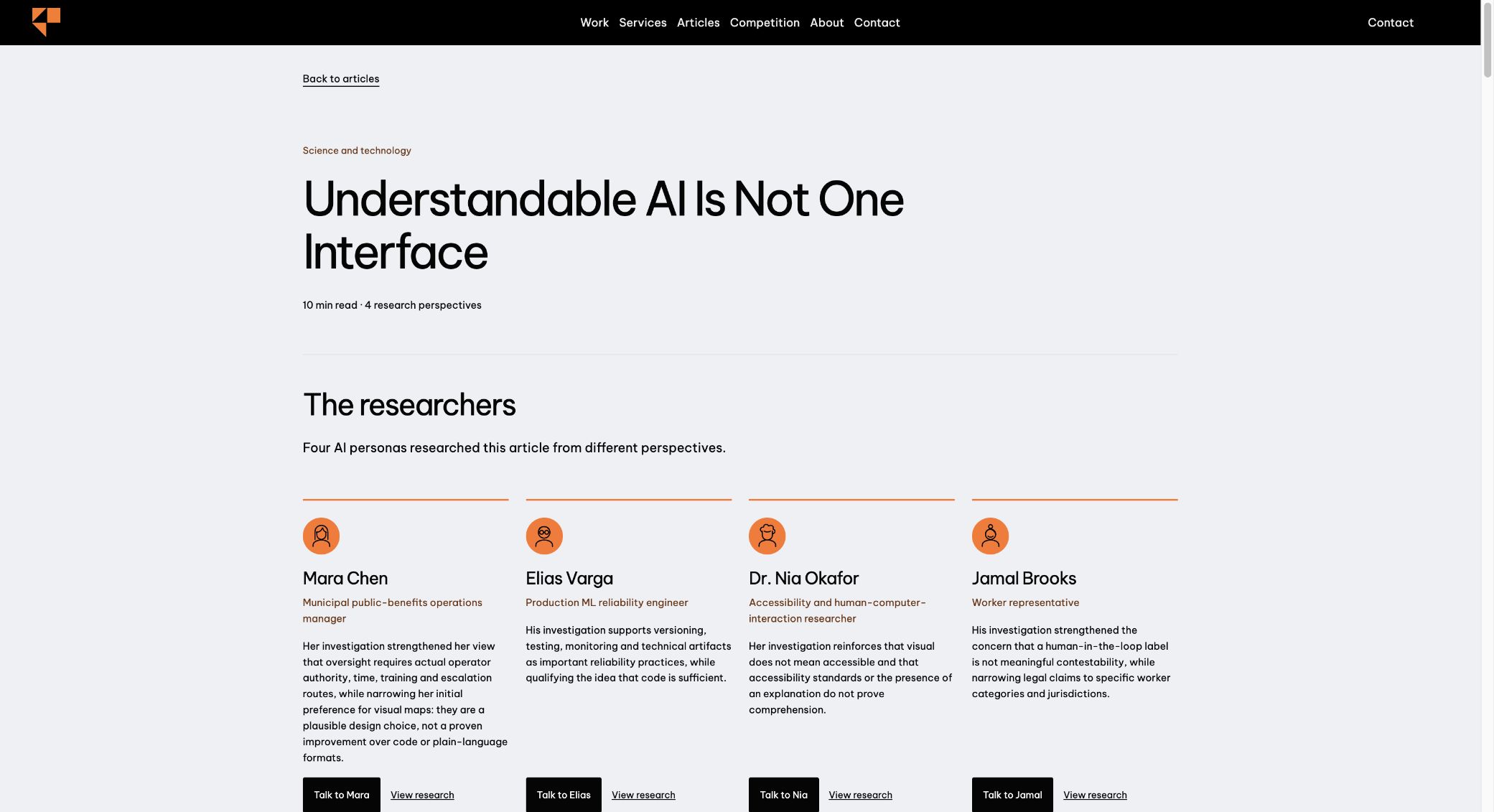
Actual public Living Article reader with its saved article and four AI research personas.
Our own development project: Living Article. Explore the saved output and the engineering behind it.
See our work ↗

Build & repair

One useful system.
Built with you.

Connect a task across your tools, build a first agent or repair a workflow that needs attention. We use visual n8n workflows, skills and scripts, with clear boundaries and checks shaped around real examples.

What does delivery include?

We agree the connections, scope limits, acceptance checks and client responsibilities before building. Your experts review representative results. The agreed delivery includes documentation and a walkthrough; ownership, licences and supplier costs are made explicit.

Continuing collaboration

Keep a hand
in what changes.

A useful system gives you something to learn from. We can work alongside your team to investigate results, refine guidance, test changes and build confidence in looking after the work.

How can continuing help work?

Through agreed sessions or a defined block of time. We specify the systems and work covered, your team’s involvement and how additional changes are agreed. Support hours and incident handling depend on the arrangement.

Real
examples
Recorded
results
Expert
judgement
Considered
changes
Illustration: changes are reviewed against the work that matters, including gains, regressions and review effort.

Choose how to resource the work

Extra engineering.
Your knowledge stays involved.

You can build internally, bring us in for a defined piece of work, or have us work alongside your engineers. Here is how the responsibilities differ.

With Pattern WorksBuilding in-house
Bring in engineering help for an agreed piece of work.Allocate internal engineering time or recruit for it.
Work with us to draw out the knowledge behind the task.Make time to capture and organise the guidance yourselves.
Develop and test an agent or workflow together.Choose the tools, build the connections and run the tests.
Receive the agreed documentation and a walkthrough.Prepare your own documentation, ownership and handover.
Add continuing help when there is useful work to do.Arrange ongoing maintenance and improvements internally.

Both routes depend on people who know the task. Your experts help shape guidance and judge the results.

Book a 30-minute discovery call ↗

A clear scope.
A considered quote.

We quote for the work you need. Effort depends on the task, existing systems, access, complexity, testing and the time needed to work with your experts. Where uncertainty is substantial, we can agree a bounded investigation first.

Before paid work starts, we agree deliverables, responsibilities, acceptance checks and fees. Tool subscriptions, hosting and model or API usage are identified separately, including any authorised testing budget. Changes to scope are agreed before extra work.

The practical questions.

Do we need a technical brief or an n8n expert?

A few examples of the work are enough to begin a conversation. You need someone who understands the task and can help judge results. We can help identify the technical work and explain how the system operates.

Who owns the accounts and pays for the tools?

Our recommended starting point is for your business to own its operating accounts, billing and recovery access. We help with setup and use named access. The quote identifies any n8n, hosting or other subscriptions separately from our work; the account and billing arrangement is agreed before setup.

How do API keys and AI usage costs work?

We agree which providers and access methods fit the task, who pays them and what spending is authorised. Where an API account is needed, we recommend a business-owned account with appropriate access. Enter keys through the service’s credential system; keep them out of enquiry emails. A chat subscription and API usage are separate purchases.

What does experimentation include?

We agree the questions to investigate, the engineering time and any supplier-usage budget before paid tests. We use representative examples and review the results with your team. If more time or usage is needed, we agree it before extending the work. A useful finding may be a reason to change direction or stop.

Where will the system be hosted?

That depends on the tools, data and operating requirements. We assess whether a suitable cloud service meets the need or whether another arrangement is required. Hosting, data location, access and responsibility for administration are agreed as part of the scope.

How do you test whether it works?

We start with a manageable set of inputs, develop the evaluation metric with you and use deterministic checks and, where useful, an LLM judge. Your experts review the findings and recommendations with us, and we test changes against the same cases.

How we run evals
Can you take over an existing workflow?

We can scope an investigation or repair. First we need to understand the current workflow, access, dependencies and available records. Any ongoing support depends on that assessment and an agreed scope.

What happens after delivery or when we stop working together?

The scope sets out the deliverables, ownership and licences, documentation, walkthrough and access handover. We explain relevant platform or third-party dependencies. Continuing help is optional; covered systems, hours, incident handling, changes and extra charges are agreed explicitly. There is no automatic promise of round-the-clock support.

Can you work with the tools I already use?

Yes. n8n, Airtable and GitHub are our preferred starting points for this approach, with Supabase where it fits. We examine your existing tools, connections and access before recommending changes. You do not need to move everything into a new stack.

How do shared skills stay up to date?

We can keep the source in a shared GitHub library, review and test changes, and agree how each person or agent gets the approved version. GitHub provides the history; installation and rollout are part of the setup. Changing an AI provider or agent environment can require adapting the connections and testing the skill again.

Bring a task you want an agent to help with. We’ll discuss the tools, guidance and review process it needs, then agree the scope and quote.

Book a discovery call